How to structure your knowledge into a training program
From “I know a lot about this” to a program someone can buy, finish and recommend.
 Teducas team
, 7 min read
Knowing a lot about a subject is not the same as having a training program. A program is a concrete promise: whoever finishes it will be able to do something they couldn't do before. Everything else (modules, videos, materials) serves that promise.
1. Start with the outcome, not the syllabus
Write in one sentence what your student will be able to do when they finish. "Understand digital marketing" doesn't work; "launch their first campaign with a $10 daily budget and measure the result" does. That sentence decides what goes in and what stays out.
2. Design the path backwards
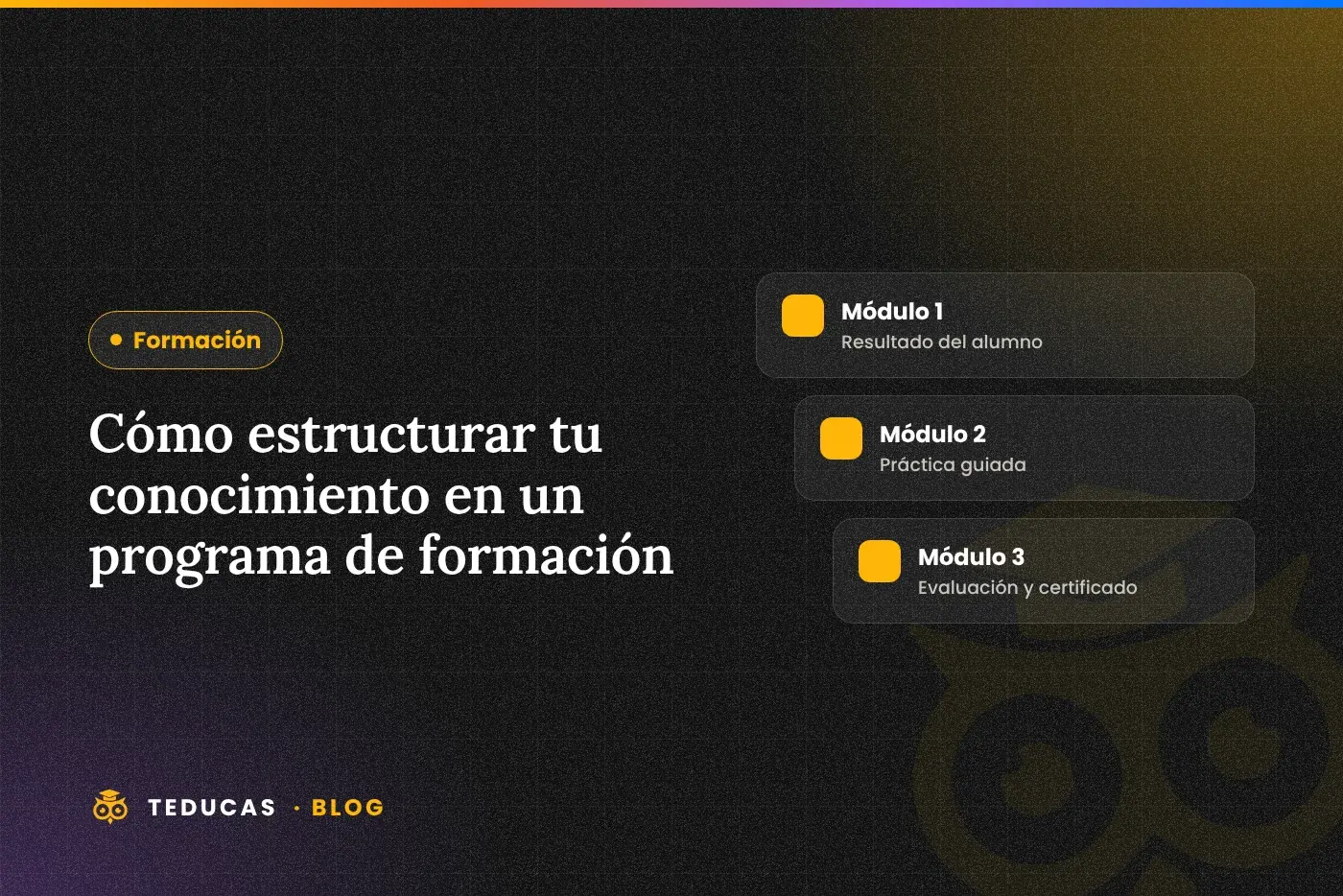
Starting from the outcome, ask yourself what the student needs to be able to do right before achieving it, and before that, and so on until you reach their starting point. Each step is a module. If a topic doesn't appear on that path, it's probably a bonus, not part of the program.
3. One lesson, one action
Every lesson should end with something the student does: a completed template, a decision made, an exercise submitted. Lessons that only inform are the ones people abandon most.
- Length: 5 to 15 minutes per lesson usually works better than hour-long blocks.
- Materials: one downloadable guide per module is worth more than ten loose documents.
- Assessment: measure whether the student can perform the action, not whether they remember the theory.
4. Validate before you record
Before producing the full course, teach it live to a small group. A two-hour workshop tells you which parts raise questions, which ones are unnecessary and what language your students use. Recording afterwards is faster and the result is better.
5. Choose the format based on the outcome
A simple outcome fits in a low-priced recorded course. A deep change needs coaching, community or certification. The format isn't an aesthetic preference: it depends on how much support the student needs to achieve the promise.
If you want to work on your program's structure with someone by your side, a consulting session is a good place to start.